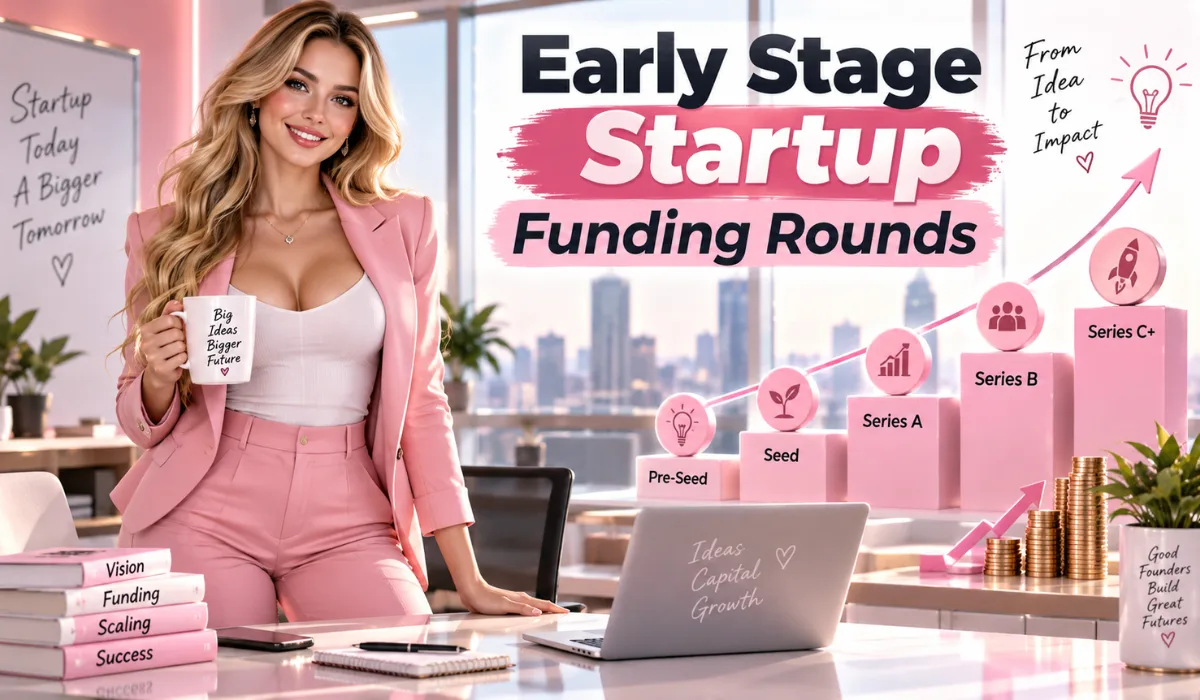
Early stage startup funding strategies are structured financial plans used to secure capital during a company's initial growth phases. Primary options include bootstrapping, angel investment, and venture capital. Success in 2026 requires focusing on unit economics, maintaining a 24-month cash runway, and utilizing instruments like SAFEs to balance rapid scaling with founder equity retention.
The New Reality of Startup Capital
Raising money today feels significantly different than it did in previous cycles. The "growth at all costs" era has been replaced by a demand for extreme efficiency and clear paths to profitability. For a founder, your funding strategy is the blueprint that determines how much control you keep and how fast you can scale.
In 2026, investors are no longer buying into vague dreams; they are buying into disciplined execution plans backed by data. Navigating this landscape requires a mix of high emotional intelligence and hard financial metrics. If you do not master your capital strategy, the market will dictate your company’s fate for you.
What Is an Early Stage Funding Strategy?
An early stage funding strategy is a technical roadmap for acquiring the financial resources needed to transition from an idea to a scalable business. It typically spans three main phases: Pre-seed (concept validation), Seed (market entry), and Series A (scaling the model).
These strategies involve choosing the right financial instruments—such as equity, convertible notes, or revenue-based financing—to fuel operations. The primary goal is to obtain enough "runway" to reach the next major valuation milestone without over-diluting the founders' ownership.
Read also: Why Is Funding Important for Business and Startup Success
Why Funding Strategy Is Critical in 2026
The 2026 investment climate is defined by "selective capital." While global liquidity remains high, money is flowing exclusively toward startups that demonstrate high capital efficiency and "applied AI" solutions. A clear strategy signals to institutional investors that you are a low-risk operator.
Without a strategy, founders often fall into the trap of "panic raising," which leads to predatory terms and loss of board control. In a high-speed economy, having your funding secured allows you to focus entirely on product innovation and customer acquisition rather than constant fundraising.
Key Benefits of a Structured Funding Plan
- Accelerated Market Entry: Strategic capital allows you to bypass the slow crawl of organic growth and capture market share before competitors can react.
- Access to "Smart Money": The right investors bring more than cash; they provide "institutional knowledge" and high-level connections that lead to strategic partnerships.
- Operational Stability: Ensuring your "burn rate" is covered for at least 24 months allows the team to focus on long-term product-market fit rather than short-term survival.
- Top-Tier Talent Acquisition: Experienced engineers and executives are more likely to join a startup that is well-capitalized and backed by reputable venture firms.
How the Startup Funding Process Works

The journey usually begins with bootstrapping, where founders self-fund to build a Minimum Viable Product (MVP). This is often followed by a Pre-Seed round, involving friends, family, or "micro-VCs" who provide the initial $100k to $500k for early development.
Once the product shows "traction"—meaning consistent user engagement or revenue—the Seed Round begins. Here, angel investors provide the capital needed to find "product-market fit." Finally, Series A involves institutional VCs who invest $5M to $15M to turn a proven success into a scalable machine.
Real-World Application: The 2026 SaaS Model
Consider a 2026 SaaS startup specializing in AI-driven logistics. The founders bootstrapped for six months to build a beta tool. They then used a SAFE (Simple Agreement for Future Equity) to raise $750k from angel investors, allowing them to sign their first ten enterprise clients.
With a proven Customer Acquisition Cost (CAC) and high Lifetime Value (LTV) data, they successfully pitched a Series A. They secured $8 million by showing exactly how that money would be used to automate their sales funnel and expand into European markets.
Common Mistakes and Myths to Avoid
- The "More is Better" Fallacy: Raising excessive capital can lead to bloated operations and unrealistic growth expectations. It is often better to raise exactly what you need to reach the next milestone.
- Neglecting the Cap Table: Every percentage point of equity given away early is gone forever. Founders must model future dilution to ensure they remain properly incentivized through later rounds.
- Over-reliance on AI Hype: In 2026, simply claiming to "use AI" is insufficient. Investors demand to see proprietary data sets and "moats" that competitors cannot easily duplicate.
Expert Insights on 2026 Investment Trends
Industry experts highlight that "Applied AI"—AI that solves specific industrial problems—is the most funded sector this year. Additionally, there is a growing trend toward "Impact Investing," where founders are rewarded for showing social or environmental benefits alongside financial returns.
Current data suggests that the average time to close a Seed round has increased to four months. Founders are advised to start their "investor relations" at least six months before they actually need the money to build necessary trust and rapport.
Who Should Pursue Early Stage Funding?
This path is ideal for founders aiming for high-growth, high-impact markets. If your business model relies on "network effects"—where the service becomes more valuable as more people join—you will likely need external capital to reach critical mass quickly.
However, if you are building a service-based business or a niche product with high margins, you might consider "alternative" funding like revenue-based financing. This allows you to grow at a healthy pace without answering to a board of directors or giving up equity.
Read also: Impact Of Funding On Startup Growth
Pros and Cons of External Funding
Pros:
- Immediate access to massive growth resources.
- Validation and mentorship from industry leaders.
- Ability to take calculated risks that wouldn't be possible while bootstrapping.
Cons:
- Significant dilution of founder equity.
- Increased pressure to provide 10x or 100x returns.
- Strict oversight and rigorous reporting requirements to investors.
FAQs
What are the most common early stage funding options? The most common options include bootstrapping, angel investors, venture capital, and crowdfunding. In 2026, revenue-based financing and SAFEs are the preferred methods for SaaS and AI startups to scale efficiently.
How do I calculate my startup's valuation? Early stage valuation is typically based on total addressable market (TAM), the experience of the founding team, and current "traction." In 2026, proprietary data assets and AI integration are the primary drivers of high valuations.
What is a SAFE agreement? A SAFE (Simple Agreement for Future Equity) is a contract where an investor provides capital in exchange for the right to buy stock in a future funding round. It is the industry standard in 2026 because it is faster and more founder-friendly than traditional debt.
Final Verdict
Early stage startup funding strategies are the engine of modern innovation. To succeed in 2026, you must pair your visionary thinking with rigorous financial discipline. Whether you choose to bootstrap or pitch to VCs, your strategy should always prioritize the long-term health and equity of the company.
Build a product that solves a painful problem, keep your "burn rate" low, and treat your investors as long-term partners in your vision.